

A lot of my thinking recently has been around the factors that enable a great company to be built— models and frameworks to spot potential that has the chance to morph into something generational. As I’ve echoed numerous times, I tend to focus on the team first and foremost: how authentic is the founder? Are they obsessed with what they’re building, acting on their generative drive? Are they learn-it-alls, customer-obsessed, and great at hiring? From the team emanates the product— building what’s not only a magical customer experience, but products that have great business genetics. Products that act as enabling agents of value-creative activities customers couldn’t engage in otherwise, emerge as a system of record and center of gravity for their users, and where value creation lends itself to value capture in creating product-business model resonance.
But as good as any founding team and their product is, it’s incredibly hard for a boat to generate any real motion at sea without the existence of wind in its sails. Many believe a company needs to target a big market to have a chance at winning; I see a big yet open market as a non-equilibrium outcome in a system governed Darwinistically by the invisible hand. If a market is big at first glance, it will likely be populated by several players and carry a high degree of fragmentation, and hence the way to build an enduring company is by entering with a radically better product (think Google entering search). The other, more common scenario, is starting with a small market that holds the potential to grow rapidly, and building a company that turns that potential kinetic en route to explosive value creation in a compressed amount of time.
That gets us to the question of what creates this market potential energy? What is the driver of these tailwinds, outside forces not in a company’s control, that act as catalyzing points enabling a company’s existence? Embedded in the story of every great company was a “why now” — a reason for why that precise point in time was the only moment that the given company could’ve been built, based on a confluence of factors that combined in a way to enable explosive value creation. Understanding the nature of those factors and how they enable market potential energy to be created has been a lot of what I’ve been thinking deeply about, with this piece being an exploration of that curiosity. Let’s dive in.
Supply Potential
Technological dislocations— changes in the underlying technology set that enable the emergence of new primitives to design against, fundamentally alter the space of what’s possible. They open up a new palette to paint with that wasn’t available previously, expanding the surface area of creative expression for the great entrepreneurs. These technical catalysts serve as preconditions to the building of disruptive companies native to that dislocation, creating the supply potential that was nonexistent a priori. Look throughout history for every company thought of as iconic, chances are they took advantage of a secular technological dislocation, a wave upon which their surfboard was in prime position. The Uber product was possible because of the prevalence of mobile technology combined with newly available data from Google Maps APIs. Instagram and Snapchat are similar cases— made possible by smartphone technology with 3G and better cameras. YouTube was able to exist thanks to broadband internet and Adobe flash in browsers.
The same holds true on the enterprise side as well. Salesforce, ServiceNow, and Workday— all pioneers of the SaaS (software-as-a-service) model, were able to arise at precisely the time they did thanks to the increasing pervasiveness of the Internet, which enabled a fundamentally new software delivery mechanism. Prior to the Internet and cloud, enterprise companies would sell their software via CD-ROM discs that were customer-hosted. Installations would take 6-18 months, and the only way the software could be updated was by paying the vendor for maintenance. Massive service contracts, not the value of the software itself, served as the lifeblood of these on-prem enterprise software businesses— until the Internet emerged as a force for massive disruption. All three of these companies were able to displace their respective incumbents in the space due to the importance of being native to the internet and having on-demand delivery in their product DNA.
In fact, all three founders of these first generation SaaS companies had worked with the incumbent prior to starting a disruptor. Marc Benioff knew Tom Siebel, the founder of Siebel Systems (Salesforce’s on-prem CRM predecessor), fairly well— he worked with him at Oracle and was even an early angel investor in Siebel Systems. Benioff even had conversations with Tom Siebel about his vision for a SaaS CRM and had been invited to join Siebel, but knew that the full potential of his vision could only be actualized in an independent startup rather than division of an incumbent. As he’s written in his book, Behind The Cloud:
“I told Tom about the SaaS CRM solution I envisioned. We would have “subscribers” pay a small monthly fee ($50 to $100, which added up to less than half the cost of the traditional systems), and we’d “operate” it so there would be no messy installation for the customer. Tom liked the idea so much that he invited me to join Siebel. Through further discussions, however, I realized that Tom saw the potential only with the small business division, a tiny percentage of Siebel’s market. I saw the idea as having much wider appeal. I thought it was something that could revolutionize the software industry. I knew Internet-based applications would eventually replace traditional offline software. I became passionate and obsessed with this idea, and decided to go after it on my own.”
Workday’s story hums a similar tune. Aneel Bhusri, the founder of Workday, had originally spent 6 years at PeopleSoft, the HR incumbent. Originally planning on working at Norwest Venture Partners after finishing his MBA at Stanford, Bhusri was convinced to join Peoplesoft after striking a friendship with founder Dave Duffield. Duffield would eventually exit the CEO role in 1999, and Oracle would acquire the company a few years later. Bhusri and Duffield, seeing Salesforce’s rapid ascent in this next-generation SaaS world, knew what had to be built for the reinvention of HR software— and also knew that it couldn’t be simply tacked on to an incumbent. It needed its own company, its own internet-native DNA, its own fresh start. Bhusri and Duffield started Workday in 2005, and the rest is history.
Fred Luddy, the founder of ServiceNow, was previously the CTO of Peregrine Systems, the incumbent in IT-service management software. Peregrine imploded for reasons other than being slow to adapt (an accounting scandal rendered them bankrupt in 2003), but the realization Luddy had was similar to his SaaS counterparts: the future of software was delivering it over the Web rather than with CDs, with it being vendor-hosted and paid for via a monthly subscription model. Two weeks before his 50th birthday, Luddy started ServiceNow, a company that would grow rapidly en route to a 2012 IPO and current market cap of $163B.
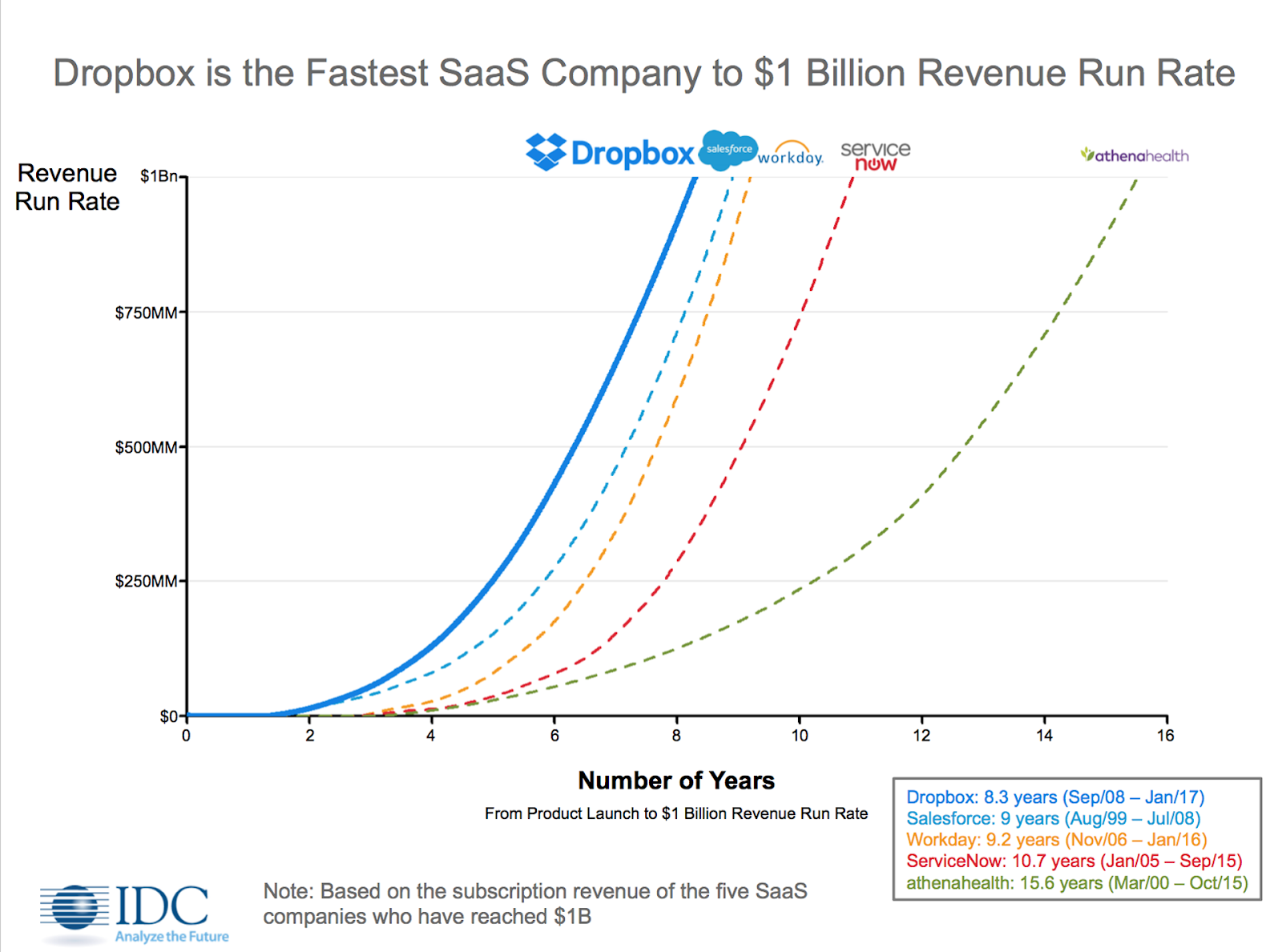
Until Dropbox eclipsed them in 2017, the three SaaS pioneers were the three fastest companies to $1 billion in ARR— it took Salesforce 9 years, Workday just over 9 years, and ServiceNow 10.7 years. Radical revenue growth, which is the hallmark of any venture-backed startup, hardly happens solely thanks to a great team and great product. All three companies saw massive supply potential in the technological dislocation that was the internet, and built companies native to that change to capitalize on it. The results speak for themselves.
Demand Potential
While supply potential encompasses a company’s ability to build a completely novel product with an array of novel aspects, it doesn’t directly hint at market expansion. Where the magic really happens is when supply potential helps create demand potential, leading to a reinforcing feedback loop that creates opportunities to build great companies.
Supply potential creates demand potential by shifting and expanding the set of behaviors that can be expressed. For each instance of supply potential, there exists a broad space of possible demand potential, and the subspace of that which manifests boils down to what best aligns with the incentives of agents in the system. For enterprises, it’s the space of things that’s value creative— whether in making something easier, faster, and cheaper, or enabling a completely new activity that’s of value. I think of enterprises as homo economicus— on a long enough timescale, they’re operating under economic incentives, so any product that intersects this embedded reward maximization curve will be one whose usage will be an equilibrium state.
Let’s revisit the rapid ascension of Salesforce, Workday, and ServiceNow. Could this growth have been predicted and forecasted with a top-down TAM analysis done in the early 2000s? No, because the underlying technology set was different, and a top-down analysis done then would fail to account for how much potential demand the new supply potential would be able to activate. The newly enabled enterprise behaviors of increased Web activity, combined with the persistent incentive to spend less money on software, created the perfect storm of demand potential for SaaS products. Why would a company want to fork over money in massive service contracts for installation and maintenance when they could just buy the software over the Web and get it the instant they purchased it? This demand couldn’t exist pre-Internet because the technology wasn’t there to deem it possible; it was a far-off dream at best. But with the supply potential created by technical dislocations emerged the possible behaviors now in the space of expressible demand; the combination of the two is what leads to rapid market growth.
It’s also interesting to look at the generational cloud infrastructure companies through this lens. AWS’s cloud computing breakthroughs— namely S3 and EC2– served as creators of supply potential. The cloud, combined with both Internet expansion and mobile, led to an explosion of data that was flowing into these enterprises, creating the demand potential that would be harnessed in the building of Snowflake, Databricks, MongoDB, Elastic, and Confluent. The cloud also created new surface area for security threats and attacks, leading to an increase in expressed demand for cloud security products— hence emerged CrowdStrike, Okta, and others.
On the consumer end, intuiting the possibility space of expressible demand boils down to thinking not only in terms of homo economicus, but also the core motivators that make humans who we are. Every great consumer company appeals to one or more of our deep-seated human incentives, to build a company that grows in a rapid manner. Uber spoke to the human motivator of convenience and ease of use, YouTube to the human craving for entertainment and desire to self-express, and Instagram to our innate nature as social creatures. These are all vectors of demand that are native to who we are as human beings, and can only be expressed when a certain technology dislocation alters that space of possible repeatable behavior. The supply potential creates the demand potential, and the self-reinforcing nature of the two creates the conditions for rapidly growing markets. The great companies exist at their convergence.
Uber: From Taxi & Cab to Ridesharing
A good example to concretize this is the story of Uber and the market expansion they tapped into. In 2014, when Uber was worth $17 billion shortly after their Series D funding round, Ashwath Damodaran (an NYU Stern professor who’s often referred to as the Dean of Valuation) published a piece where he expressed his belief that Uber was overvalued. In his analysis, Damodaran used the TAM of the existing taxi & cab market, an element of his argument that early Uber investor Bill Gurley would rebut in his seminal piece on the topic. In Gurley’s words:
“In choosing to use the historical size of the taxi and limousine market, Damodaran is making an implicit assumption that the future will look quite like the past. In other words, the arrival of a product or service like Uber will have zero impact on the overall market size of the car-for-hire transportation market. There are multiple reasons why this is a flawed assumption. When you materially improve an offering, and create new features, functions, experiences, price points, and even enable new use cases, you can materially expand the market in the process. The past can be a poor guide for the future if the future offering is materially different than the past.”
While this specific example of Uber has since matured in a roller coaster ride to the public markets, the underlying logic still persists: top-down analysis on market sizing implies an inert nature of markets, which fails to account for the emergent behavior that creates new demand in response to exogenous catalysts. In the case of Uber, the company did expand the taxi-cab market into an overall ridesharing market— they did so through a process of tapping into newly spawned pockets of market potential energy at precisely the right point in time. Mobile technologies and Google Maps APIs created the potential energy of supply to build such a product, and the increasing consumer activity and reliance on their mobile devices, the emergent behavior arising from the intersection of new technology and timeless human nature, created the demand potential.
By building a radically better product that was both cheaper and better to use, applying a scalar to an already existing vector that consequently changed its form, Uber brought ridesharing into the collective threshold of plausibility. They enabled ordering an Uber to be a rational (and hence repeatable) consumer decision in situations where previously ordering a taxi may not have been, and hence had a significantly broader base of customers to target than those who had historically used taxis. The creation of the market potential energy was completely exogenous to that company, yet turning that potential kinetic and expanding a market into that new region takes a magical product experience that transcends the constraints previously thought to be true.
For startups, the window of timing is immensely crucial. The situation is symmetrical whether one is too early or too late: the company ends up having to fight an uphill battle against competitors to gain share in an existing market space rather than tapping into the potency of new territory. Even if a product is 10x better than what’s currently being sold, the rapid revenue growth so deeply synonymous with startups is incredibly hard when a market is in a fixed state. Explosive value creation happens when companies can exploit a critical state, akin to a pile of sand where the next grain will induce an avalanche. Going after a market in a static state begets linear growth; nonlinear growth is only possible when the creation of market potential energy enables a sense of dynamism.
Market Potential Energy in Generative AI
The fun part about studying the past is seeing how it maps to the present, and it just so happens we are in the midst of another technological dislocation: generative AI. Rooting from the great work done at Google in inventing the Transformers model architecture, large language models have now emerged as a new paradigm from which pockets of supply potential have been created. The supply potential exists both in applications that can be built on top of these models (think chatbots like ChatGPT, copilots like GitHub copilots, and even agent-based products) and in a new set of infrastructure companies solving the pain points inherent in bringing LLM use-cases into production. The emergent behavior arising from the combination of new technology and timeless human nature creates the bedrock from which expressible demand is possible, pulling acts like interfacing with a chatbot to harness its reasoning capabilities or outsourcing mundane tasks to agents into the realm of normalcy. Changing human behavior propagates into changing enterprise behavior, creating a potential energy of demand for AI-native products that either make internal activities 10x more efficient or help deliver a 10x better product.
Especially on the enterprise side, the secular nature of this shift will only reveal itself more as time goes on. In their Q4 earnings call, ServiceNow reported that their generative AI products contributed more net new ARR in its first full quarter than any other product family ever had in the company’s lifetime. Given the homo economicus nature of enterprises, it’s likely that more and more companies gravitate towards such value-creative opportunities in response, using LLM infrastructure products wherever necessary to optimize the transition from playground to production.
I’ve been vocal on my belief in the AI infrastructure space, as echoed in a past article I’ve written. I’m as bullish as ever on companies here— Chroma to supercharge retrieval, Unstructured for expanding the space of usable enterprise data, Together for more efficient use of customizable open-source models, and Voyage for domain-specific embedding models all come to mind. They’re harnessing both a potential energy of supply and a consequent potential energy of enterprise demand to build an AI infrastructure business at precisely the perfect time, and I’m excited to see their journey in turning that energy kinetic.
On the application side, I often think about the amount of conviction and foresight it required to invest in SaaS in 2003. Just like the internet enabled a new business and delivery model of software-as-a-service, LLMs invert that in enabling what I think of as service-as-software. While present-day software sells a scalar, an input, on an existing vector of work, LLMs enable companies to sell the vector, the output of work, itself. Contrast this to copilots: while they’ve worked well (GitHub copilot alone is doing over $100M in ARR; Twillio’s CustomerAI, Zendesk’s Answer Bot, and Salesforce’s Einstein are also well-positioned) and have immense promise, it’s principally an incumbent strategy— they have the distribution, data, business model, and user experience to build a winning product right away. Copilots are a way for incumbents to retrofit their current products to AI, within the frame of their existing paradigms; for startups to have a chance of disrupting, they need to counterposition themselves in a way that demonstrates real AI-nativity.
Few examples of the above are emerging already. Codegen is leveraging LLMs to build multi-agent systems for code generation, targeted initially toward codebase-wise use-cases like large migrations, refactoring, integrations, and bug fixes. Founder Jay Hack, who’s previously worked at Palantir, describes the product this way:
“This [product] entails orchestrating a swarm of agents that collaboratively decompose and solve large tasks. Many LLMs effectively deliberate and build upon each other’s work, [which] yields significantly better outputs. We scrape a company’s backlog, find the solvable tickets, then spin up an army of agents to find the relevant code and produce a pull request.”
While existing products like GitHub copilot may make developers incrementally faster (depending on the developer), Codegen has the potential to make developers radically more productive, freeing them up from menial tasks and enabling them to spend their finite hours on real expressions of creativity. Another company existing on this vector of selling the work rather than just the software is Quilter, who’s building what they think of as a “compiler for circuit boards”, automating the manual and tedious process of translating an electrical architecture into a manufacturable circuit board design. Akin to developers spending time on refactoring and bug fixes, most electrical engineers are still “compiling code” by hand— Quilter seeks to change that by automating the entire process of circuit board design, from placement and routing to stackups and pours.
Products like these demonstrate the promise of AI-agent-based solutions: automating fungible tasks to enable humans to iterate 10x faster and spend their time on work that’s non-fungible. SaaS was one business model transition that took major steps forward in better aligning incentives between buyers and sellers (value capture based on the performance of software rather than massive service contracts); this new paradigm of service-as-software could further that by charging based not on the ability to complete work, but on the work itself. Zapier, a $5B workflow automation company, is already doing this, having unveiled a pay-per-task business model in January.
These markets are bigger than most would initially presume, especially because this new paradigm shifts the customer’s frame of mind from spending on software to spending on labor, much like the cloud shifted compute from CapEx to OpEx. As Sarah Tavel from Benchmark has written:
“When you sell work, the sales cycle is different, it’s priced relative to the cost of a human performing the work instead of as a productivity improver, and the competition for a similar product (besides the company’s own human capital) is essentially outsourced groups internationally. An AI-driven product with the consistency and SLAs it can achieve should be vastly superior to an outsourced offering – a 10x and cheaper opportunity.”
Supply potential has been created with the wave of innovation in LLMs, and will only increase as the models get better and more performant (both closed-source and open-source). Demand potential will similarly rise in response, with AI-native behavior becoming more and more normal as the models become better. 10x cheaper products relative to alternatives bring in completely new buyers into the set of possible customers, much like SaaS enabled software companies to target both large enterprises and SMBs alike. Cheaper products change the entire “build versus buy” equation and bring buying certain products into the realms of plausibility when previously building it in-house was the unanimous choice; this trend will only amplify as agents become more effective and economies of scale further drive costs down. There’s a vast expanse of market potential energy for AI products that will only grow in the next 10 years, and I’m more than excited to see the world-class teams that take on the challenge of turning it kinetic.